
VirTech Bio Presents OxyBridge™ Preclinical Safety Results at MHSRS 2025
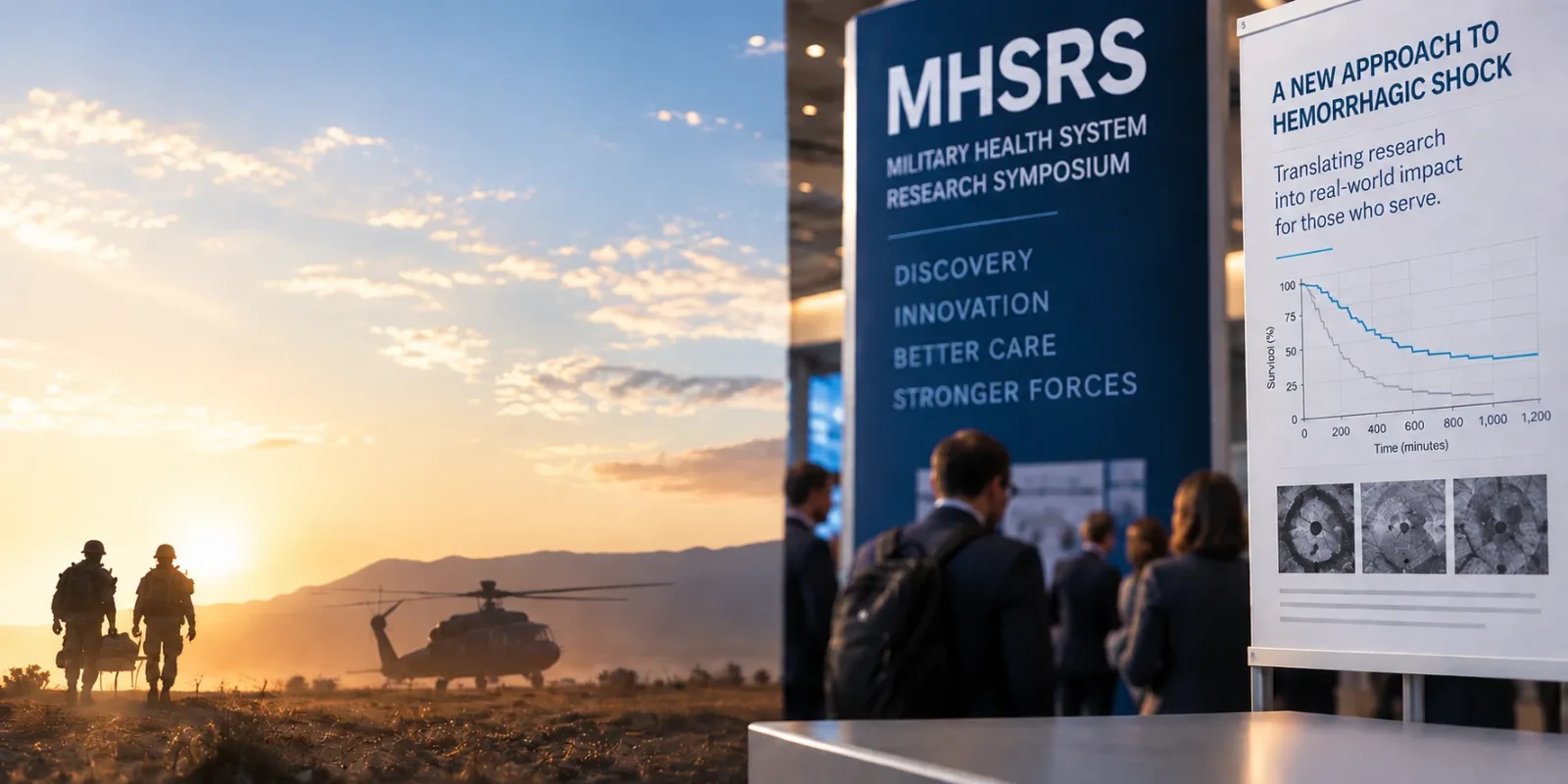
VirTech Bio CEO Dr. Dallas Hack presented OxyBridge™ at the 2025 Military Health System Research Symposium, held from 4 to 7 August 2025 at the Gaylord Palms Resort in Kissimmee, Florida.
The presentation, entitled Evaluation of a Hyper-Polymerized HBOC (OxyBridge) in a Topload Swine Model, included the results of a pilot study designed to flag potential safety issues. The study demonstrated that OxyBridge™ infusion maintained but did not increase blood pressure any more than an infusion of lactated Ringer’s solution, an improvement over earlier HBOC candidates. Other blood and cardiovascular metrics also remained normal. The authors note that fully powered studies with a vehicle control group are needed to confirm the findings. The study was conducted with Song Biotechnologies and funded by the Defense Medical Research and Development Program.
MHSRS is the principal forum for military medical research in the United States, bringing together thousands of leaders from the Department of War and the scientific and medical research community each year.
The forum is where the clinicians who treat battlefield injury and the researchers working to improve those outcomes meet. Hemorrhagic shock is high on that agenda and has been for two decades. Blood loss remains a leading cause of preventable death on the battlefield, and blood itself is often unavailable at the point of injury. It requires refrigeration, it requires type matching, and it requires a supply chain that forward positions, rural hospitals and disaster response frequently do not have.
OxyBridge™ is designed for that gap. It is an oxygen carrier made from human hemoglobin, polymerized into a molecule large enough to remain in the bloodstream rather than leaking out of it. It requires no refrigeration and no blood typing, has a long shelf life, and is supplied ready to infuse.
Preclinical results in animals do not fully predict outcomes in people. Nevertheless, a large number of preclinical studies in multiple animal models are required before human clinical validation can proceed.
“The problem has not changed since my assignment as the Director of the Combat Casualty Care Research Program: blood loss kills, and blood is rarely where the injury is. What has changed is that we now have a next-generation molecule that solves the issues with previous generations, and a plan to take it into the clinic,” said Dr. Dallas Hack, CEO of VirTech Bio.